

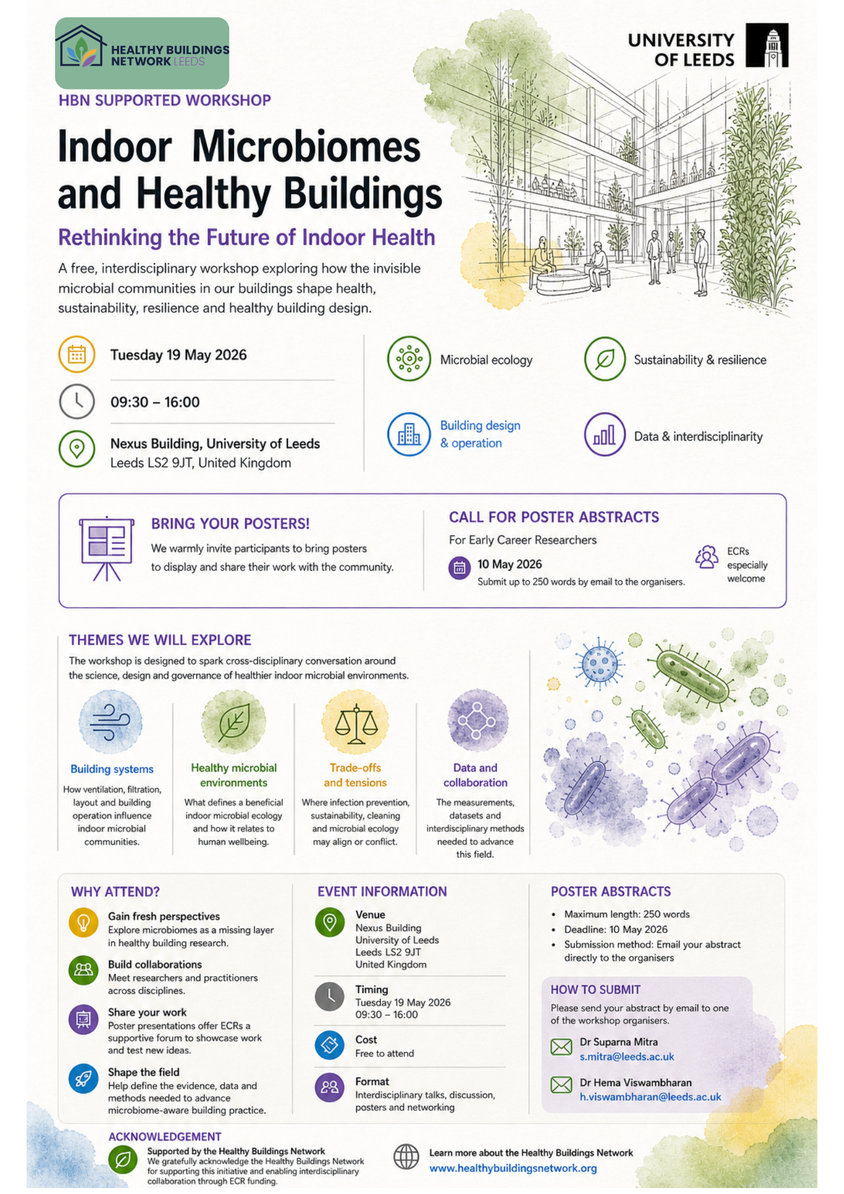
On 19 May 2026, more than 40 researchers, early-career scientists, and practitioners gathered at the Nexus building on the University of Leeds campus for a workshop with an unusual premise: rather than asking how to make buildings cleaner, they asked whether "clean" was even the right goal.
The event — Indoor Microbiomes and Healthy Buildings: Rethinking the Future of Indoor Health — brought together specialists from engineering, microbiology, architecture, environmental science, public health, and data science. It was organised by the Healthy Buildings Network as part of our ECR-funded project led by Dr Suparna Mitra, with contributions from Dr Hema Viswambharan, Dr Michael Baidu, and Dr Paula Avello Fernandez. By the end of the day, the conversation had shifted in ways that have real implications for how we design, certify, and inhabit our buildings.

Setting the Scene: Buildings Shape Exposure
The workshop opened with a keynote from Dr Marco-Felipe King, HBN co-director, titled Designing for Health: Opportunities and Constraints in Healthy Buildings. His framing was direct: every decision taken when designing or retrofitting a building — where to place a vent, what materials to use, how much natural light to admit — shapes what occupants are exposed to, including the invisible microbial world they share their space with.
This set up the central tension of the day. Buildings are not neutral containers. They are active participants in shaping the microbial ecosystems that their occupants live and breathe within. The question the group would spend the next six hours unpacking: what do we actually want those ecosystems to look like?
"A key outcome of the discussions was a shift in perspective — from viewing buildings as passive structures to recognising them as dynamic socio-ecological systems, in which microbial communities interact continuously with occupants, materials, environmental conditions, and behaviours."
— Workshop Report, Dr Suparna Mitra
What Actually Shapes Your Indoor Microbiome?
Roundtable discussions in the morning session surfaced a surprisingly long list of factors that determine the microbial character of a building: ventilation design (natural versus mechanical), airtightness, temperature, humidity, the materials your walls and floors are made from, how people move through spaces, whether pets are present, and even whether you use a hand dryer or a paper towel.
Crucially, these factors don't act independently. One example resonated across the room: airtight buildings, designed to be energy-efficient, can inadvertently trap moisture if ventilation isn't carefully managed — creating the precise microenvironments in which condensation, dampness, and mould thrive. The decarbonisation agenda and the healthy-buildings agenda are not automatically aligned, and this workshop made that tension explicit.
Participants also identified a significant measurement gap. Microbial counts alone don't tell you enough — they rarely reflect functional or pathogenic potential, and environmental data is almost never integrated with behavioural or clinical datasets. Building a meaningful picture of indoor microbial health requires joining up data that currently lives in separate silos.
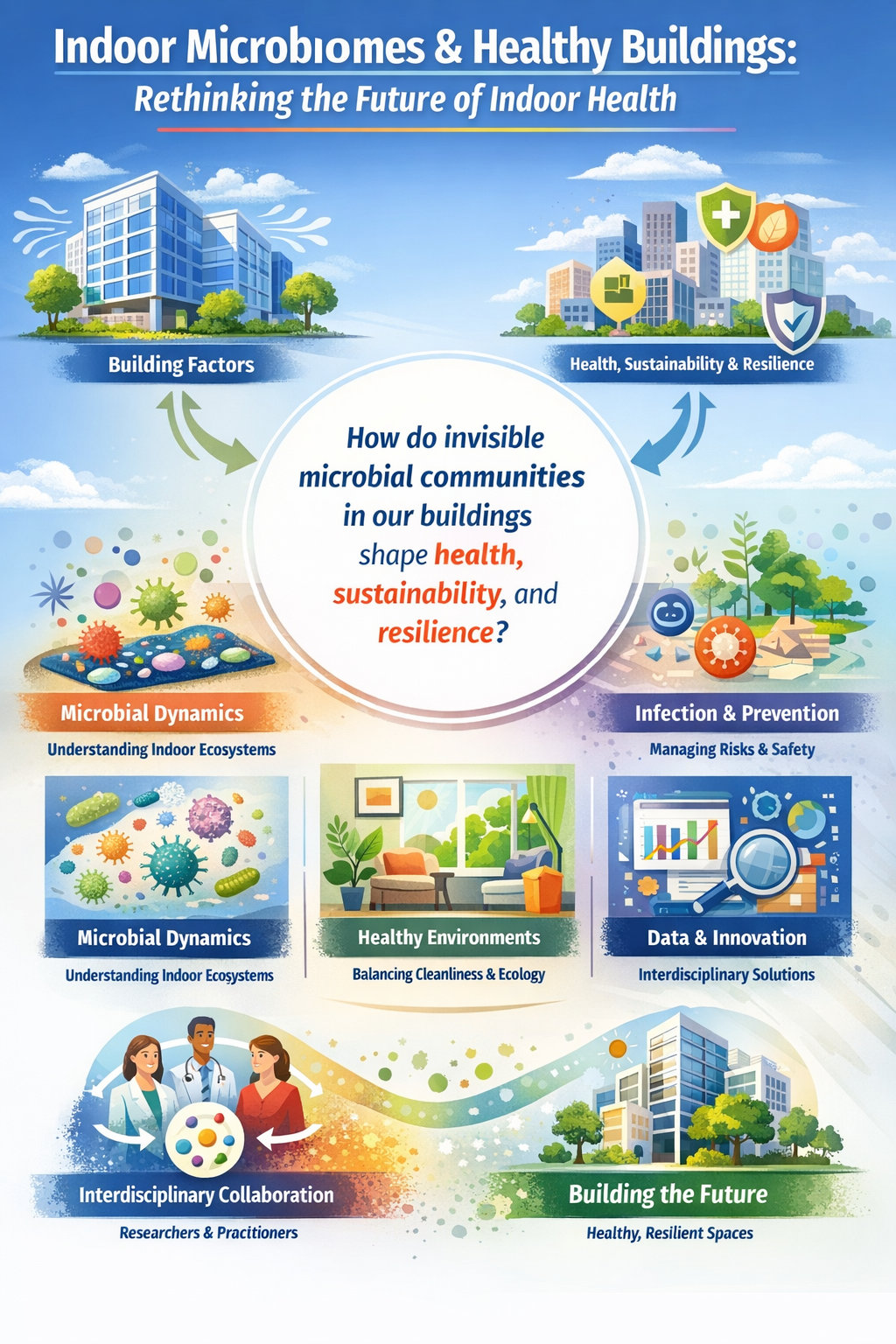
Expert Talks: Buildings as Microbial Landscapes
The afternoon began with four invited talks that grounded the abstract discussions in concrete research. Each one added a new dimension to the picture.
Prof David Pearce — Functional Resilience in Microbial Communities
Prof Pearce presented evidence that geographically diverse households share a common "core home microbiome" despite differences in location and occupancy. His key finding: microbial function may remain stable even when microbial composition changes. This has profound implications for how we define a "healthy" indoor environment — shifting the target from species counts to functional resilience and stability.
Dr Ana Pitol — Pathogen Transmission and Building Design
Dr Pitol explored how building design directly shapes airborne transmission pathways and exposure risks. Far from being a passive backdrop, the built environment actively determines how pathogens move, concentrate, and persist — making design decisions as relevant to infection control as clinical protocols.
Dr Daire Cantillon — Homes as Reservoirs of Chronic Respiratory Pathogens
Discussions focused on how homes can act as persistent reservoirs for chronic respiratory pathogens — and not just as passive sites. Biofilm formation in plumbing, aerosol generation from sinks and hand dryers, and the reintroduction of contaminants following flooding were all raised as underappreciated amplification pathways. Antimicrobial resistance (AMR) generated within buildings through sub-lethal cleaning exposures was flagged as a growing concern.
Dr Lia Chatzidiakou — Fast Screening for Mould Risk at Scale
Dr Chatzidiakou demonstrated how data-driven approaches can identify mould risks across large housing datasets — shifting building management from reactive to proactive. The prospect of scalable, algorithmic screening tools for indoor air quality represents a practical pathway from research to real-world impact.
Together, the talks reinforced a consistent message: buildings function as active mediators of microbial exposure, not passive environments. Design decisions, materials choices, and maintenance practices all leave microbial signatures.
Early Career Researchers Take the Floor
The lunchtime poster session gave early career researchers the chance to showcase their ongoing work and spark direct conversations with speakers and practitioners. The Nexus building — designed as an open innovation space with flexible, collaborative zones — proved an ideal setting: posters lined the main atrium, conversations spilled across tables, and the informal energy of the session visibly carried through into the afternoon discussions.
The Big Question: What Does a Healthy Indoor Microbiome Actually Look Like?
The afternoon session tackled perhaps the most fundamental question in the field, and the one with the least consensus: what should we be aiming for? Participants debated whether "healthy" should be defined by diversity, stability, functional traits, pathogen suppression, or resilience to chemical exposure.
There was broad agreement on one point: healthy does not mean sterile. Overly sterile environments may disrupt the beneficial microbial communities that support immune development, ecological balance, and resilience to environmental stressors. The concept of "probiotic ventilation" — deliberately introducing beneficial microbial diversity into indoor air — was discussed with genuine interest. The relationship between indoor microbial diversity and immune development in children attracted particular attention.
Healthy indoor microbiomes represent a multi-dimensional construct — incorporating ecological, functional, and health-related parameters. A single metric cannot capture it, and a single intervention cannot deliver it.
The Tensions No One Is Talking About
One of the most valuable outcomes of the afternoon was an explicit mapping of the trade-offs that currently sit unresolved — and largely unacknowledged — within building design and policy:
| Trade-off | The tension |
|---|---|
| Infection prevention vs ecological balance | Excessive sterilisation may disrupt beneficial microbial communities |
| Energy efficiency vs ventilation | Net-zero goals can conflict directly with healthy ventilation rates |
| Intensive cleaning vs microbial resilience | Chemical cleaning alters indoor microbial ecosystems and may contribute to AMR |
| Sustainability vs chemical burden | Some green building interventions introduce unintended environmental impacts |
These aren't abstract tensions. They show up in everyday policy decisions — when a decarbonisation strategy prioritises airtightness without mandating adequate ventilation, or when a hospital infection-control protocol optimised during COVID continues indefinitely without re-evaluation of its microbial side effects.
The Privilege of Ventilation
One concept that emerged from discussion — and immediately stuck — was what participants called the "privilege of ventilation". Opening a window is frequently promoted as a simple, low-cost intervention for improving indoor air quality. But that assumes you have windows that open. Occupants of basement flats, high-density social housing, or spaces like the London Underground often don't. In winter, or in buildings where heating costs are paramount, the social calculus around window-opening is very different for those on lower incomes. The ability to control your indoor environment, it turns out, is not equally distributed — and healthy-buildings research has not fully reckoned with this.
Four Ideas That Cut Across Everything
Buildings are ecosystems
Not containers. They actively interact with occupants, materials, and ventilation systems to shape complex, evolving microbial communities.
Health ≠ sterility
A healthy indoor environment supports beneficial microbial balance and ecological resilience — not just pathogen elimination.
Behaviour is as important as design
Ventilation habits, cleaning routines, and hygiene practices are modifiable, low-cost intervention points — but they're rarely designed for.
Data integration is the bottleneck
Environmental, microbiological, behavioural, and clinical datasets remain fragmented. Joining them up is the prerequisite for meaningful predictive models.
What Comes Next
The final session translated discussion into direction. Participants identified six priority research areas for the field:
- Development of standardised healthy indoor microbiome indicators
- Integration of microbiome science into building standards and regulations
- Indoor antimicrobial resistance ecology
- Ventilation–microbiome interaction studies
- Links between indoor environmental exposure and health inequalities in vulnerable populations
- Multi-disciplinary data integration frameworks
Leeds was consistently identified as an ideal testbed for this work. The combination of engineering, microbiology, and data science expertise on campus, alongside access to real-world housing environments and strong links to local public health and policy, positions the University as a natural leader in developing pilot studies, integrated datasets, and the kind of translational frameworks that can bridge laboratory findings with building regulations.
A Field at a Turning Point
Indoor microbiome research sits at an unusual moment. The tools are becoming available — cheap sensors, better sequencing, growing computational power — but the conceptual frameworks, the standards, and the policy infrastructure to make use of those tools are not yet in place. What the Nexus workshop made clear is that this is a gap worth filling urgently, and that doing so requires exactly the kind of cross-disciplinary collaboration that the Healthy Buildings Network was built to support.
The next step is to move from conceptual discussions to co-designed pilot studies. Funding applications, research collaborations, and scholarly outputs are in development. If the questions raised on 19 May 2026 find their way into building standards in the years ahead, this workshop will have been a turning point.
Acknowledgements
This workshop was organised as part of the HBN ECR-funded project on indoor microbiomes. We thank all participants, invited speakers, early career researchers, and workshop facilitators for their contributions. We are particularly grateful to the Horizons Institute, Nexus, and all members of the organising team for supporting the event. The workshop was chaired by Dr Suparna Mitra, with session chairs Dr Michael Baidu, Dr Paula Avello Fernandez, and Dr Hema Viswambharan.