
Sublethal carbon monoxide exposure doesn't just displace oxygen — it interferes directly with the electrical system that keeps the heart beating in rhythm.
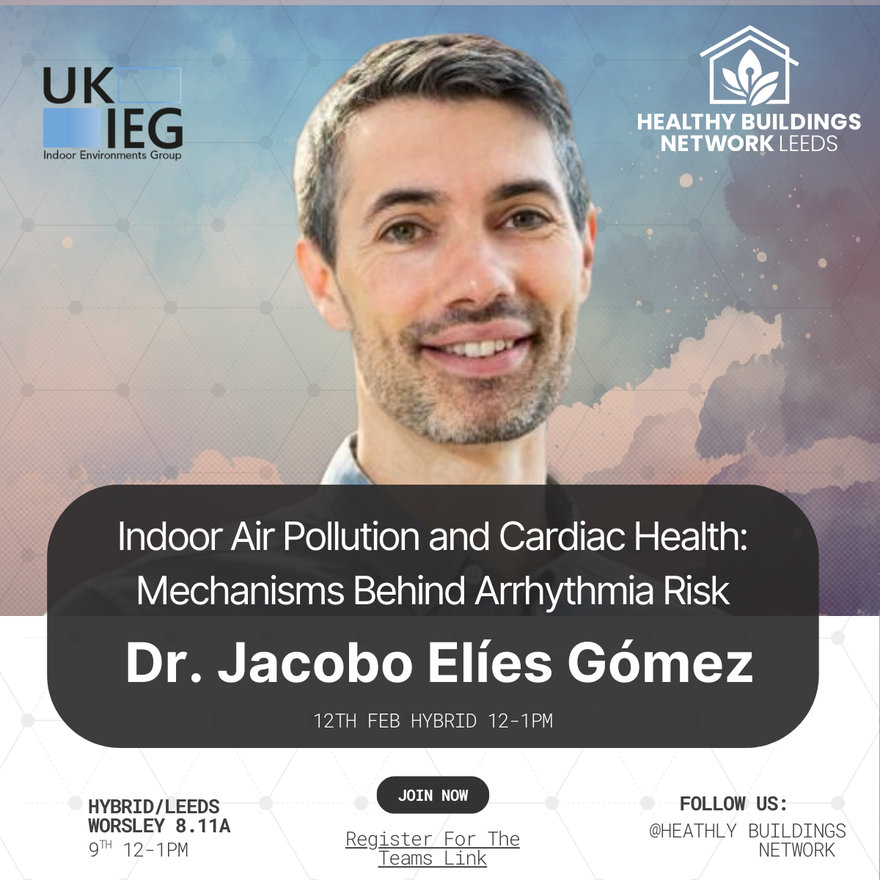
On 12 February, the Healthy Buildings Network welcomed Jacobo Elies-Gómez (University of Bradford) for a seminar that took us from real-world exposure to carbon monoxide (CO) all the way down to the nanoscopic machinery of the heart.
His message was clear: sublethal carbon monoxide exposure doesn't just displace oxygen — it interferes directly with the electrical system that keeps the heart beating in rhythm.
"CO makes the heart's electrical reset phase sluggish and unstable — a known substrate for arrhythmia."
The effect is nitric oxide-dependent, connecting environmental exposure to a specific molecular modification inside heart cells.
Carbon monoxide is often described as the "silent killer," associated with acute poisoning and emergency oxygen therapy. But Jacobo focused on something more nuanced: sublethal exposures — the kinds seen in faulty heating systems, traffic environments, smoking, or incomplete combustion indoors.
Clinicians have long observed that patients exposed to CO can develop cardiac arrhythmias. A particularly consistent feature is QT interval prolongation on the electrocardiogram (ECG) — a lengthening of the electrical recovery phase of the heartbeat.
The clinical pattern was there. The missing piece was the mechanism.

ECG Trace: QT interval prolongation is a key marker of CO-induced cardiac effects.

Action Potential: The electrical signal coordinating heart contraction.
To understand arrhythmia risk, Jacobo's lab studies ion channels — microscopic protein pores that control the movement of sodium and calcium across cardiac cell membranes. These ion flows generate the action potential, the electrical signal that coordinates contraction across the heart.
Two key players emerged:
The main cardiac sodium channel, responsible for the rapid "upstroke" of the action potential.
Critical for the plateau phase and calcium-triggered contraction.
Human iPSC-derived Cardiomyocytes
Multi-electrode arrays for integrated electrical behaviour
Patch Clamp Electrophysiology
Isolating sodium channel behaviour
Calcium Imaging
Monitoring intracellular calcium waves
In cardiomyocytes exposed to sublethal CO:
The effect was nitric oxide (NO)-dependent.
Carbon monoxide activates neuronal nitric oxide synthase (nNOS), increasing nitric oxide production. Nitric oxide then nitrosylates the Nav1.5 sodium channel, modifying its behaviour and prolonging late sodium current.
When nitric oxide synthase was inhibited (using L-NAME), the CO effects were largely suppressed. Biochemical assays confirmed increased nitrosylation of the sodium channel in the presence of CO.
A key question from the audience focused on reversibility and long-term implications. Jacobo reported that:
In post-seminar discussion, an intriguing systems-level question was raised:
Could a pathway such as CO → neuroinflammation → microbiome dysbiosis → autonomic dysregulation → arrhythmia be plausible?
Jacobo noted:
This highlights a frontier area: connecting electrophysiology with systemic environmental biology.
The seminar closed with practical reflection. For carbon monoxide specifically:
Maintain gas boilers and heating systems
Install and maintain CO detectors
Be cautious with indoor combustion sources
Reduce incomplete combustion where possible
💡 Small behavioural shifts — even replacing aerosol sprays with roll-ons — can reduce cumulative indoor pollutant burden.
Jacobo ended with two major research challenges:
What concentrations in vitro meaningfully reflect real-world chronic exposure?
Addressing pollution-related cardiovascular risk requires cell biologists, clinicians, engineers, architects, urban planners, and public health specialists.
Air pollution is often discussed in epidemiological terms — population risk, mortality curves, policy targets.
This seminar reminded us that behind every data point is a sodium channel, a calcium wave, a single cardiac cell whose electrical timing can be nudged off balance by invisible gases.
Understanding that chain — from combustion source to ion channel modification — strengthens the scientific case for better indoor environments.
And that's exactly where healthy buildings begin.
Jacobo is an associate professor at the University of Bradford specialising in cardiac electrophysiology and the effects of environmental pollutants on ion channel function. His work bridges molecular biology with public health implications.
If you'd like to collaborate or continue the discussion around exposure modelling and cardiovascular mechanisms, please get in touch via the Network.